




There is a specific kind of frustration that only shows up once a job is underway — the moment an operator realises the attachment on the machine was the wrong choice for the material actually in front of them. It is rarely a planning failure exactly. The job looked like a digging job from the […]
There is a specific kind of frustration that only shows up once a job is underway — the moment an operator realises the attachment on the machine was the wrong choice for the material actually in front of them. It is rarely a planning failure exactly. The job looked like a digging job from the office, and a bucket is what got loaded onto the truck. Then the first pile of broken concrete with rebar sticking out at angles arrives, or the first root ball that will not separate cleanly from the ground, and the bucket starts pushing material around rather than picking it up. An excavator grab attachment exists precisely for this moment—not as an upgrade, but as the tool that should have been there from the start for a category of work that buckets were never designed to handle.
The Real Difference Is Control, Not Just Shape
It is tempting to think of a grab as just a bucket with fingers, but that undersells what changes when an attachment can actually close around something. A bucket’s relationship with material is one-directional — push, scoop, carry, tip out. A grab’s relationship is interactive. It can grip something, feel resistance, adjust, release selectively. That difference sounds small until you watch someone use a grab to lift a single awkward beam out of a pile without disturbing everything around it, something that would be essentially impossible with a bucket’s edge. The grab does not just move material differently — it lets the operator make decisions about individual pieces rather than treating everything as one undifferentiated mass.
Demolition Material Does Not Cooperate
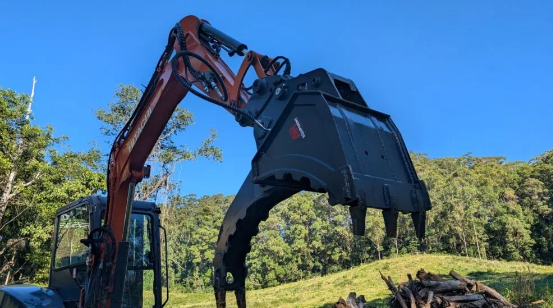
Anyone who has tried to load mixed demolition debris with a bucket knows the specific rhythm of frustration involved — scoop, watch half of it roll back off the edge, reposition, scoop again, watch a piece of rebar catch and drag everything sideways. Broken concrete, twisted reinforcement, splintered timber, and whatever else a building leaves behind when it comes down does not sit in neat, scoopable piles. It tangles. An excavator grab attachment closes around that tangle and lifts it as a unit, including the awkward protruding pieces that a bucket edge would either snag on or simply shove aside. The time saved is not really about speed in any single moment — it is about the disappearance of all those small failed attempts that, added together, eat an enormous amount of a working day.
Vegetation Fights Back, and Grip Wins That Fight
Clearing land with a bucket against established vegetation is an exercise in brute force that does not always go the operator’s way. Root balls grip the ground stubbornly, and a bucket edge driven underneath can cause a tree to shift suddenly and unpredictably — which is not just inefficient, it is genuinely dangerous for anyone working nearby. A grab attachment changes the physics of the interaction entirely. Instead of prying and hoping, the operator can grip the trunk or root mass directly, feel how it is resisting, and apply controlled pressure in a way that is both more predictable and considerably safer when working close to fences, structures, or vegetation that needs to stay put.
Sorting While Clearing Beats Sorting Afterwards
There is a hidden cost in mixed waste that most people only encounter once it reaches a disposal point and someone explains why everything now needs to be separated before it can be processed. Doing that separation after the fact, off-site, with material already loaded and mixed, is slow and often expensive in ways that were entirely avoidable. A grab attachment lets an operator make sorting decisions in real time, during the clearing itself — timber here, concrete there, metal in its own pile — because the grab can place individual pieces with intent rather than dumping everything into one container by default. The few extra seconds spent placing material deliberately during clearing routinely save far more time than that downstream.
One Machine, Several Jobs, No Waiting Around
Sites rarely involve just one type of work from start to finish. A project might begin with demolition, move into clearing, and finish with general site preparation — three different material-handling challenges in sequence. A machine that can swap to a grab attachment as the work shifts means the same excavator and operator carry through all three phases, rather than the site waiting for a different machine to arrive for each stage. That continuity is worth more than it sounds, particularly on sites where scheduling additional equipment means actual delays rather than a quick phone call.
Conclusion
The jobs that genuinely expose the limits of a bucket — irregular debris, stubborn vegetation, mixed material that needs separating — are exactly where an excavator grab attachment earns its place. The difference is not subtle once you have watched the same pile handled both ways. For any site where the material is not predictable, having a grab on hand changes a frustrating, stop-start process into one that simply moves, and that shift is felt by everyone on site, not just the operator.